
Published in Spirit of Progress, journal of the Art Deco and Modernism Society of Australia, Summer 2024.
Many years ago someone showed me a rather striking Art Deco landmark in Armadale, Melbourne on Wattletree Road, just near Glenferrie Road, that features a small tower, complete with clocks, from which horizontal strip windows with ‘eyebrows’ above, sweep round the corner, and down the side of a long thin building. They asked if it was safe from rapacious developers, and I was pleased to find that it was included in the Glenferrie Road heritage precinct, though there was no detail about. I thought it was great, then forgot about it until a couple of years ago, when one of the partners in a venture to turn the place into a hospitality venue contacted me to see if I knew anything about its history. They already had copies of three original plans, from the Stonnington History Centre, which revealed that rather surprisingly it was designed in 1940 as a dairy, but the client wasn’t noted.
A search of Trove scanned historic newspapers quickly turned up an article from 1941 with an illustration showing the striking design pretty much as built, and stating that it was for Coughlin’s Dairy.[i] So then I had a good look at the plans, and saw that one was dated 1935, which showed that the building next door, a bit obscured by a new awning, was also a diary, built across a now partly infilled space that must have been the driveway. Mainly single storey, it has nice Art Deco styling consisting of horizontal banding above the windows, contrasting with a wide vertical feature above the door. Coughlin’s must have been doing pretty well to expand only a few years later with a new building that was mainly office space, with a ‘milk bar’ up front, and that clock tower. It also has a flat roof, which was unusual for smaller buildings of the period, ensuring a clean modern look, but best of all, the stair inside that goes all the way up to that roof are sinuous circular ones, complete with circular skylight above. The plans also show that the front corner of the tower was to have glass blocks in a vertical strip, perhaps to be illuminated at night, but removed at some point.
The architect for both buildings was Norman Smith, and a search of the National Library’s Trove scanned historic newspapers turned up a limited number of projects by him, mostly in the 1930s. He must have specialised in milk related sites, with items about a butter factory in Echuca, and dairies in Port Melbourne, Thornbury, and East Malvern – the last two with illustrations showing simple single storey rectangular buildings enlivened by Art Deco horizontal ‘speed lines’, and both long gone. Judging from this, Coughlin’s 1941 dairy is his best surviving work.
Then I wondered what exactly was a diary, one located in the city ? And what exactly was the ‘milk bar’ in the front ? The Stonnington Environmental History (2009)[ii] provides an overview. Since milk was a staple but without refrigeration went off quite quickly, in the 19th century dairies were essentially a family that kept a few cows, either on their property or not far away, and they would deliver, or you would take your jug each morning to get a pint or two perhaps through a side window. In the early 20th century, with increasing concern about hygiene and the growing availability of refrigeration, a series of regulations were passed, setting new requirements, and dairies became more commercial. Each would have their own farm, or farmer clients, often outside the city, with the milk sent by rail in bulk cans, which the dairy would then bottle and deliver by horse and cart – a practice which continued into the 1970s (I have a clear memory of that from my own childhood in Camberwell). By the early 1930s most were still small concerns, with over 40 in Malvern alone, but in 1933, a new Milk Board raised standards again, leading to the closure or amalgamation of about half, and the construction or revamping of many, often in Art Deco style.
Coughlin’s 1935 building reflects this – it had an ice chamber and a cool chamber, a large area for can washing (in brine), and a large room in front just labelled ‘dairy’, probably where the milk was bottled. There must have been some fierce rivalry in this period of change, since Coughlin’s were taken to court in 1933 by rival Larcher’s for using bottles embossed with the name of his dairy, but the case was dismissed since this was common practice, and it was only the name on the thin metal cap that counted.[iii] Coughlin’s made the local news a few more times in this period when the Milk Board inspectors were unhappy with the cleanliness of the premises or the quality of the milk.[iv]
And what was the ‘milk bar’ shown in the 1940 plan ? Was it like the corner stores that were so common across Australia in the post WWII era (and now rare) ? The first milk bar is thought to be the Black & White, which opened in Martin Place in Sydney in 1932, but it wasn’t a corner store – it was inspired by US soda fountains, but with milk shakes rather than sodas, sold over the counter.[v] This concept then swept Australia, with hundreds opening in every suburb and town especially in the eastern states. Meanwhile, I found that a few other 1930s dairies in Melbourne also used the term milk bar, but one did not have a shop front, and they were relatively small, so it seems likely they were simply a place where you could buy fresh bottled milk. Then in the post-war period existing corner stores installed fridges and started to sell milk, and perhaps milk shakes, and took on the milk bar title,[vi] merging all three types of retail into one. I found at least one dairy that evolved along these lines – the simple but stylish Art Deco former Quilkeys Dairy, in Cowderoy Street, West St Kilda, was built in 1935 (also by Norman Smith), and an old heritage study photo shows was a standard milk bar by 1988, and now its a charming busy café. In New Zealand corner stores were called dairies from the late 1930s, showing an even stronger link.
Coughlin’s is very unusual for having such an eye-catching building for a dairy, and perhaps it was an over-capitalisation, or perhaps they just got a good offer, because they sold out to Leytons Dairies in 1944. Eventually, like all the others, this dairy was supplanted by milk being bottled in country areas, then delivered to city stores by truck. This change meant that few dairies were built in the city in the post-war years, and most of the dairies that remain are those from the 1930s, often in Deco style, that were put to other uses. Coughlin’s 1935 building has been a restaurant for some time, and the 1941 building now includes a very stylish bar called Harvie, that uses the ground floor space and the rooftop, accessed up that spiral stair. The partners took on this venture in part because they knew the building, and could see the potential, a case of fine architecture leading to a great new use. While Norman Smith is not a well-known architect, the bar is named after one who is; Ellison Harvie was one of Melbourne’s few female architects in the 1920s, and in the 1930s became an associate in Stephenson Turner, the hospital specialists, managing large projects like the Royal Melbourne Hospital. In 1946 she was made a partner, the first woman in such a role, and in 1959 designed the restrained Modernist woman-only Lyceum Club in the city.[vii] So pop in for a rooftop drink at sunset, admire the building, and salute the architects that have made such great contributions to our city.
All images Rohan Storey, unless otherwise noted.
[i] “Suburban Building Headway Reflected in New Dairy”, The Herald, 28 May 1941.
[ii] The Stonnington Environmental History Update 2009 can be found here https://www.stonnington.vic.gov.au/Planning-and-building/Strategic-planning/Planning-scheme-review/Reference-document-to-the-Stonnington-Planning-Scheme/Stonnington-Thematic-Environmental-History
[iii] “POSSESSION OF MILK BOTTLES. Suggestion of Vendetta”, The Argus, 28 March 1933
[iv] “Dirty Malvern Dairy”, The Age, 2 April 1936,
[v] “A short history of Australia’s milk bars”, Australian Geographic, May 15, 2018
[vi] “The slow death of the Australian icon that is the corner store (or milk bar, or deli)”, ABC News, 21 Jul 2019 https://www.abc.net.au/news/2019-07-21/the-death-of-the-milk-bar-deli-corner-store-an-australian-icon/11279638
[vii] Ellison Harvie, Wikipedia entry https://en.wikipedia.org/wiki/Ellison_Harvie

An unusually narrow design, emphasising the vertical.

The 1935 dairy is on the left, with much more stylish and prominent 1941 addition on the right, and the driveway between.
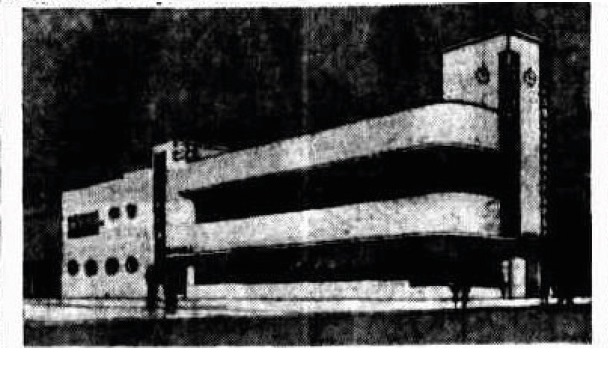
Perspective, Herald, 28 May 1941, pretty much as built.

The ground level was the ‘milk bar’, with a large curved glass window. Note the inset gap once filled with glass blocks.
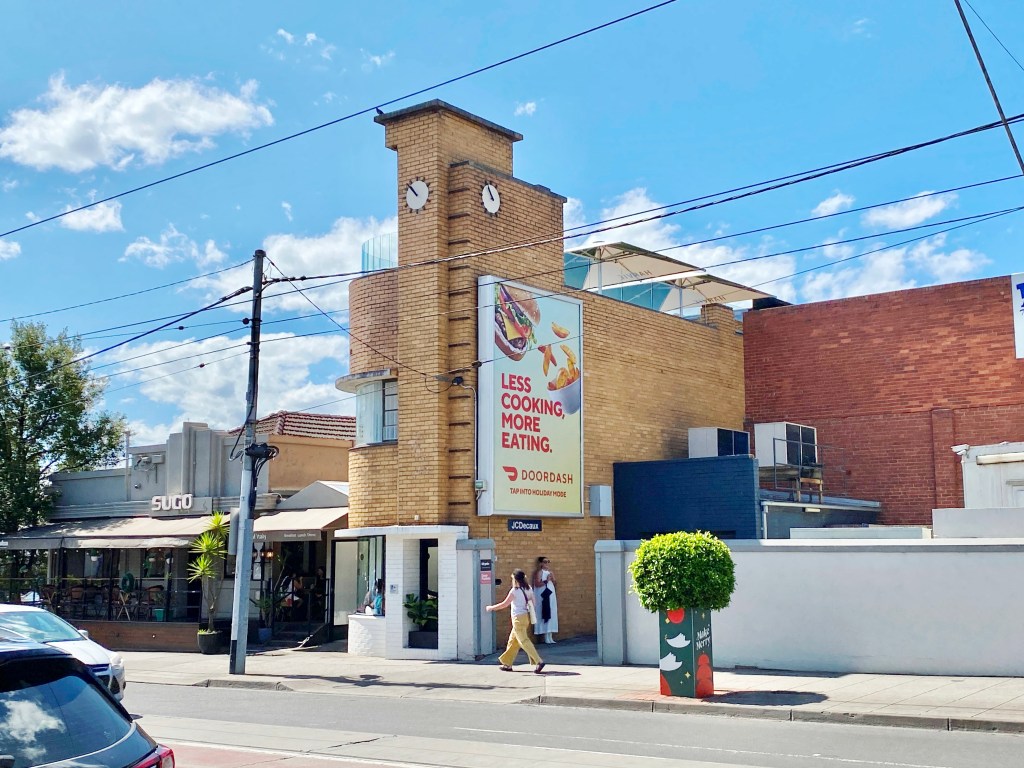
The flat west side also has a clock face.
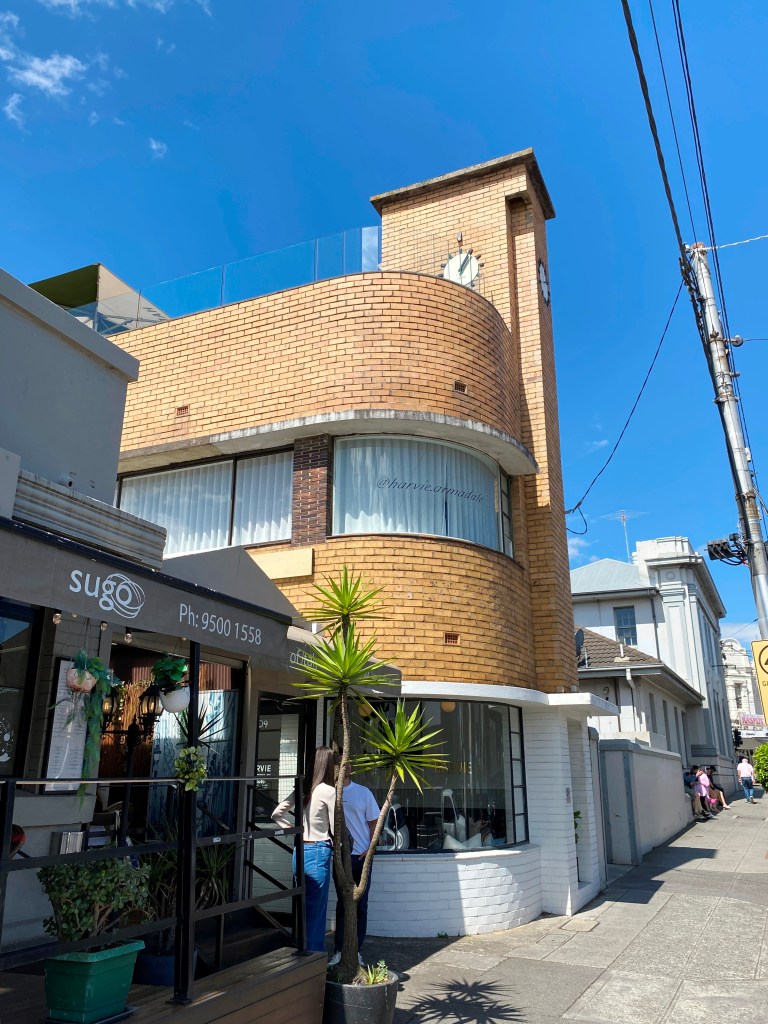
The building thrusts forward dynamically.
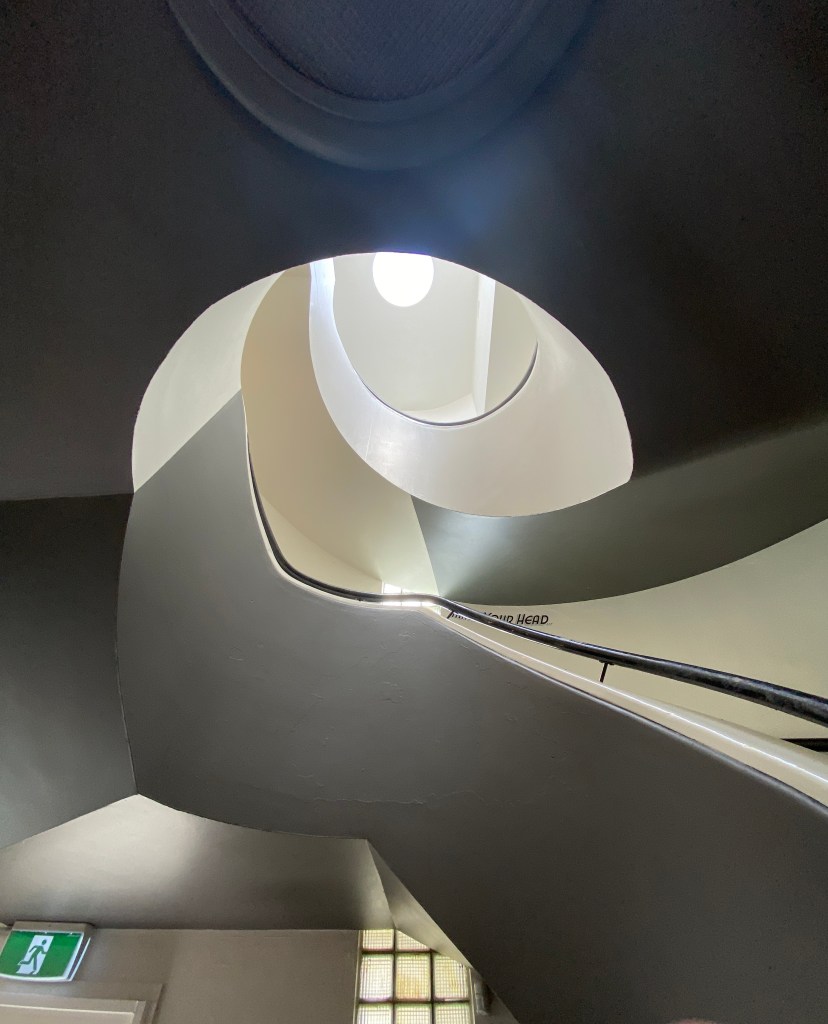
View up the stairs

View down the stairs. Image courtesy Harvie.

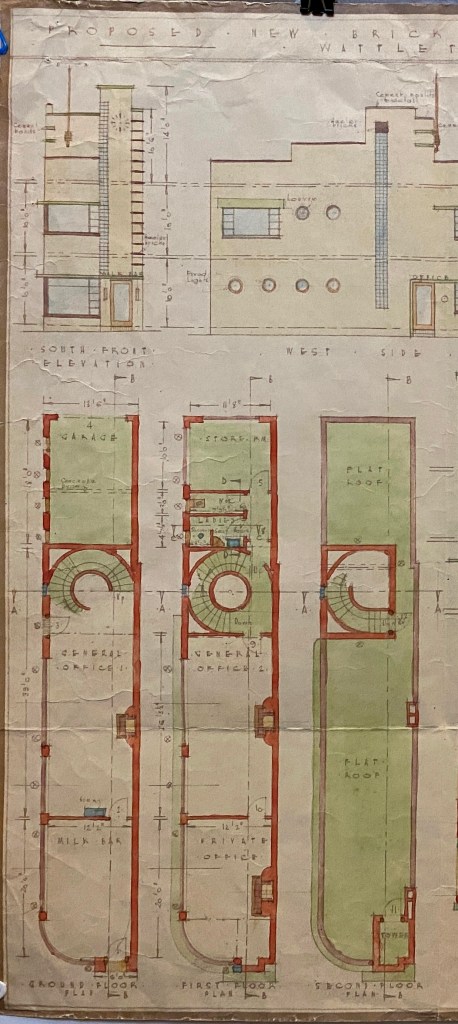
Plans, 1935 on left, 1940 on right, Stonnington History Centre.
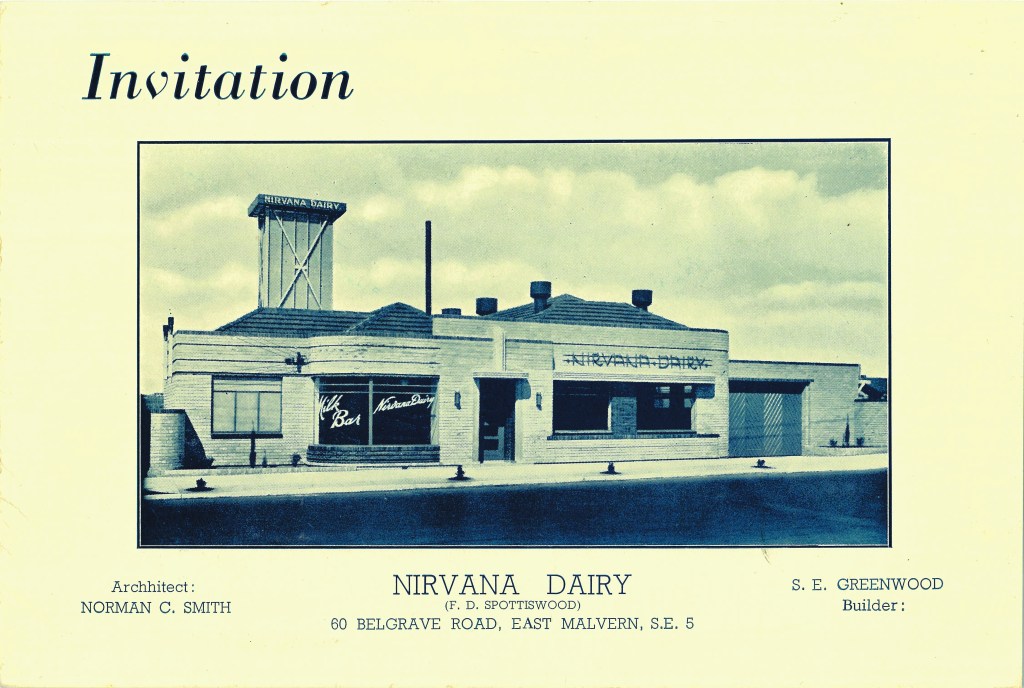
Nirvana Dairy, East Malvern, opening invitation, 25 October 1938, Stonnington History Centre
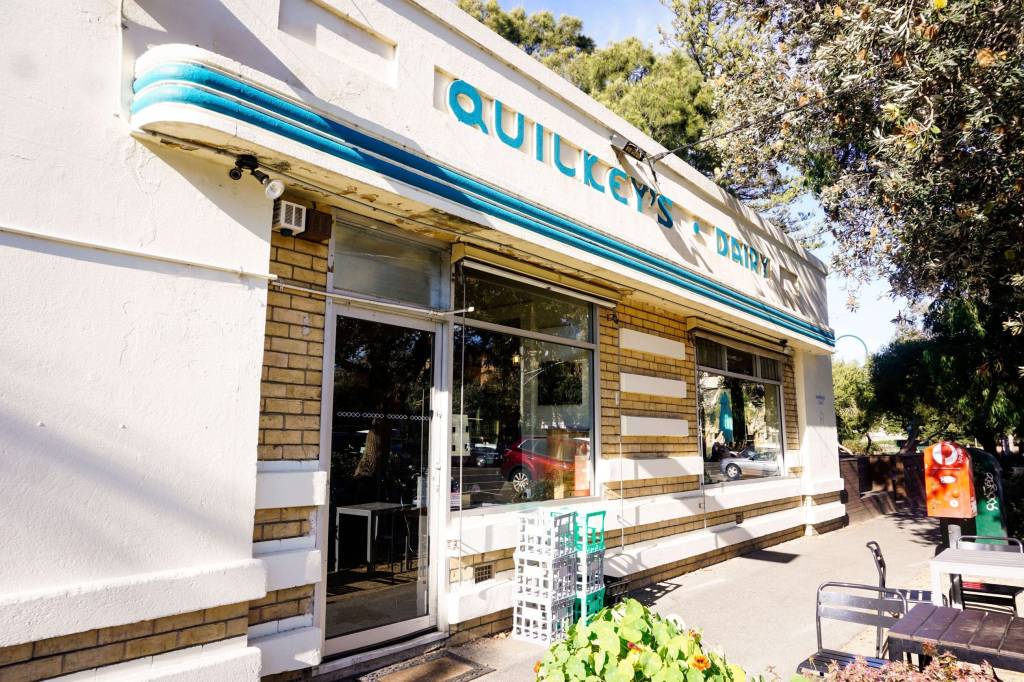
Quilkeys Dairy, 1935, West St Kilda. Image toohotornot.com
 Storey of Melbourne