
Published in Architect Victoria (magazine of the Australian Institute of Architecture, Victorian Chapter) Summer 2018
Architectural value in State heritage assessments.
The rejection by the Minister for Planning Richard Wynne of the recommendation by both Heritage Victoria and the Heritage Council for listing the 1954 APM Power House in Alphington came as something of a shock. This was possibly the first time a Minister had intervened in this way in perhaps the entire history of the operation of the Victorian Heritage Register; even previous Minister Mathew Guy, who famously called Bogle & Banfield’s 1965 Total House ‘an eyesore’, adding “..I don’t think we should be saving ugly buildings in Melbourne.”[1], didn’t intervene in the process.
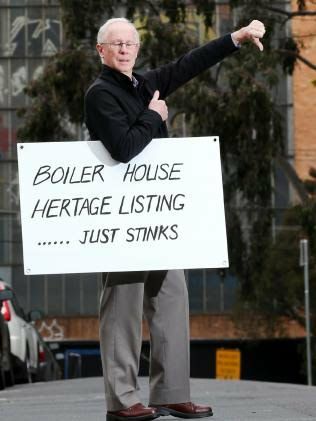

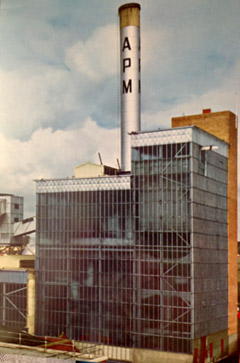
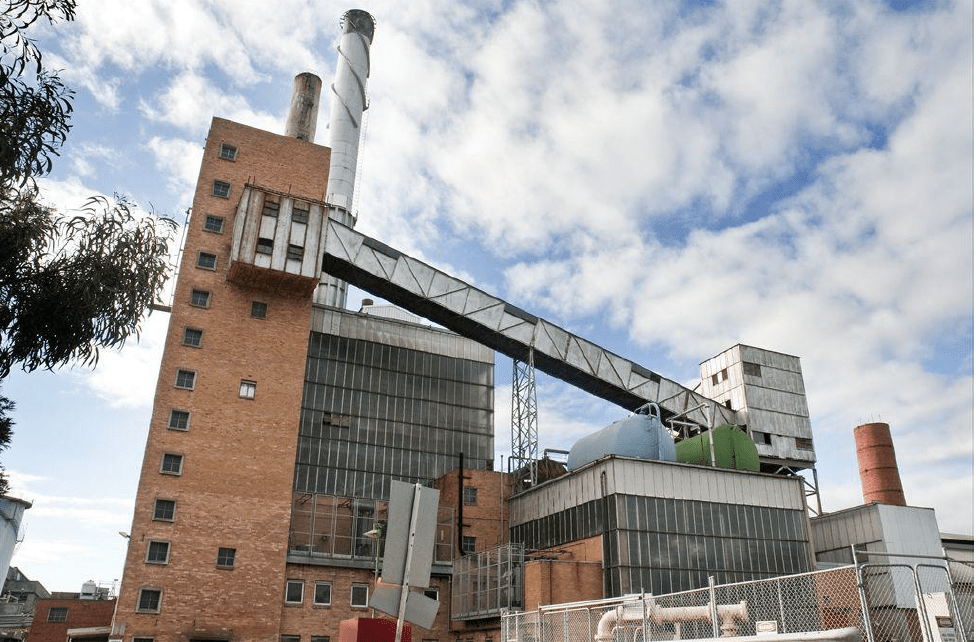
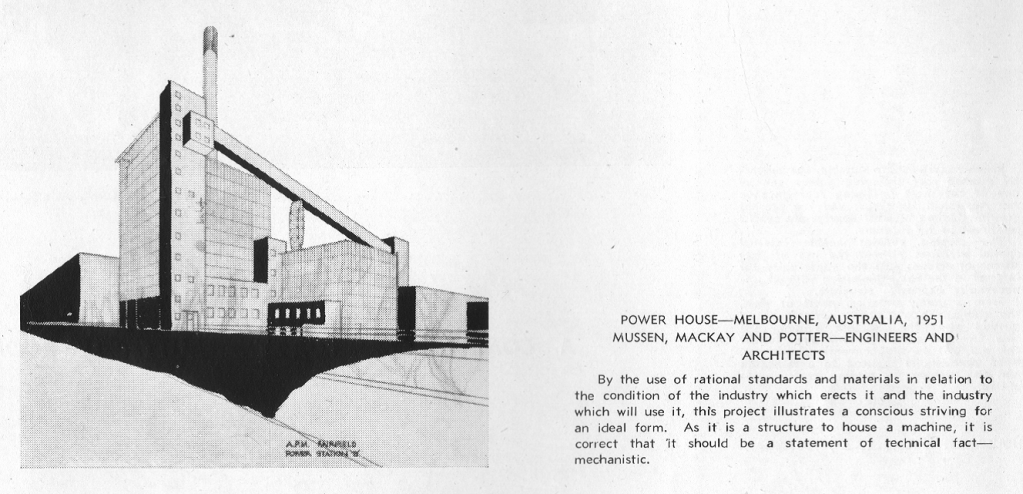
So was it all about ‘ugliness’? The Minister’s decision was clearly influenced by a vocal local group who had many concerns with the site as a whole, but seemed to have a particular fixation on getting rid of the Power House. After they (and the site’s developers) convinced Yarra City Council to support the demolition, partly on the basis that it was ugly, partly that it would be difficult and expensive to retain, a registration by Heritage Victoria was sought. Their report confirmed its high significance, as probably the most ‘designed’ functional industrial building from the period, and as the earliest large-scale glass curtain wall built in Victoria. All this evidence was for naught however, with the Minster’s media release titled “Protecting Alphington’s Character And Building New Homes” including such delights as “Submissions from local residents to the Heritage Council said the Boiler House had polluted the Yarra River, and that it is “unattractive” and “universally hated.””, and a quote ‘attributable to the Minister that “The old power station is an eyesore, a relic of the past and needs to go.” [2] I haven’t interviewed any of the people who said they felt it was ‘ugly’, but I’m certain that the focus on the Power House was because it was the tallest and most visible part of large, dirty-looking industrial site. The Power House became a symbol (as it was designed to be) of what had become an unloved, abandoned industrial site, and so stood as a symbol of the whole nasty, smelly history of the place – it was ugliness by association, and an effective local lobby group, that stopped the granting of heritage protection.
Ugliness is of course subjective, and is not a generally used criteria for heritage assessments. But whether a place can be described as a ‘good’ example of its era or style or type (or not), is still part the assessment process by Heritage Victoria, despite the establishment of criteria in an attempt to ensure some objectivity.
For some time they have used eight main criteria (A-F), covering such topics as historical, archaeological, aesthetic, technical and social significance. In 2014, these criteria were explained and expanded with a 20 page “Criteria and Threshold Guidelines” information booklet, which outlines a number of ‘steps’ for each criteria, firstly to make sure you’re filling in the right ‘box’, then more ‘reference tools’ to judge whether it meets the State level threshold for that criteria.
Out of the 56 examples given in the document, there are only seven post-war places, which to be fair reflects the range of places currently on the Register. However, the creation of the criteria, many of which are about historical attributes, and tools that reply on documentary evidence to ‘prove’ significance, creates a bias against more recent places. For instance, for a place to have aesthetic significance (criteria E), it needs to have won an award, or been written about approvingly. Simply being a bold, striking design, with obvious aesthetic impact isn’t enough, and since architectural awards were not granted in Victoria between 1942-1968, ticking that box becomes harder.
Recent assessments of post-war places have highlighted this difficulty, and the extent of value judgements still present. Lacking high historical, archaeological, social value, rarity or awards, they have been mainly assessed on one criteria, D: “Importance in demonstrating the principle characteristics of a class of place”.
The officer’s reports on the 1955 Lind House in Caulfield by Anatol Kagan, and the 1961 David Godsell house in Beaumaris make fascinating reading; the first was a ‘no’, the second a ‘yes’. They were both assessed mainly on criteria D as examples of ‘Modernist residential architecture’; the main ‘reference tool’ for criteria D is that a place must a ‘fine’, ‘intact’, ‘influential’ and / or a ‘pivotal’ example. In the comparative summaries, the Godsell house was lauded for its “..interplay of stepping horizontal roof and floor planes – together with its skilful deployment of face brickwork, timber cladding and lining boards, and very wide eaves overhangs – [which] combine to create a dwelling that is outstandingly integrated with its sloping site.”[3], while the Kagan house was downplayed as “…an assembly of many Modernist style elements [which do] not demonstrate the finely resolved and cohesive design and construction that would elevate it to State level significance.”[4]
Another place recently rejected was Mockridge Stahle & Mitchell’s 1962 Mary Immaculate church in Ivanhoe, again using only criteria D, on the basis that “..the integration of the elements and features within the Church does not present as architecturally adroit or finely resolved.”[5] It is a striking assemblage of angled walls and roofs, with a prominent copper spire, avoiding historicist elements but still obviously a church, but its apparent lack of resolution is more important than its dynamic architectural expression.
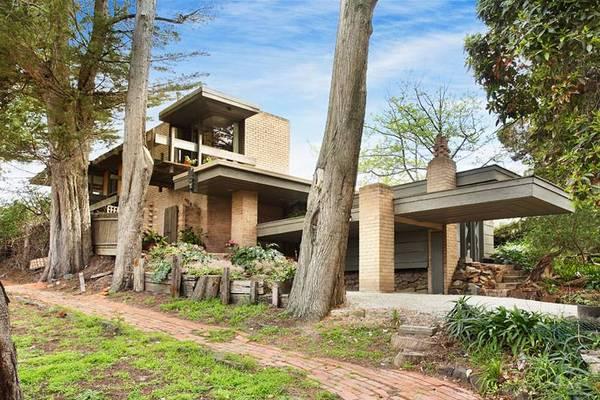
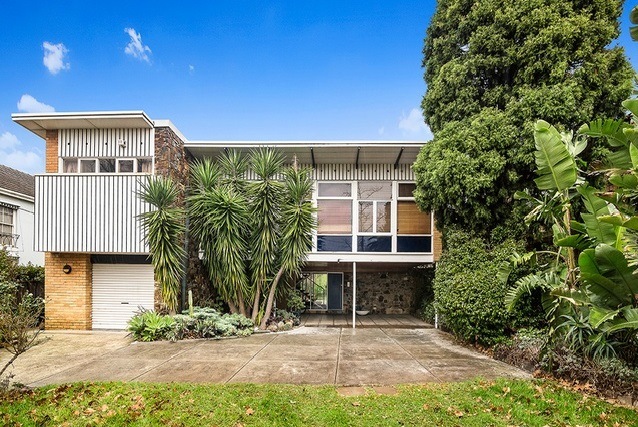
House (Real Estate photo)
To me this sounds like Robin Boyd’s successful excoriation of ‘featurism’ still influences architectural thinking today. This implies that in the future places that were outside the mainstream of modernism are going to struggle to find a place on the Victorian Heritage Register.
[Update: the Power House was demolished in 2021. On appeal to the Heritage Council, the Lind House was added to the Register in June 2018, while Mary Immaculate was extensively altered in 2021]
[1] Planning Minister Matthew Guy no fan of ‘ugly’ Hoyts Cinema building, Herald Sun, 30 January 2014
[2] Protecting Alphington’s Character And Building New Homes, Media Release, Richard Wynne Minister for Planning, 25 October, 2017
[3] David Godsell House, Recommendation of the Executive Director, Heritage Victoria, 22 September 2017
[4] Lind House, Recommendation of the Executive Director, Heritage Victoria, 22 September 2017
[5] Mary Immaculate Church, Recommendation of the Executive Director, Heritage Victoria, 17 November 2017
 Storey of Melbourne